Faux leather has become very convincing. Polyurethane (PU) and PVC materials can copy the look of leather closely, and some real leathers are coated so heavily that they look almost synthetic. That makes it harder to know what you are paying for, especially when shopping online or in markets.
No single test is perfect, but a few simple checks together will tell you a lot. None of the tests below damage the item, and you can do most of them in a shop.
1. Read the label and description carefully
Start with the words. They often tell you more than the material itself.
- Real leather terms: full grain, top grain, genuine leather, suede, nubuck, nappa, vegetable-tanned. (See our guide to full grain vs top grain leather for what these mean.)
- Synthetic terms: PU, PVC, polyurethane, vegan leather, faux leather, leatherette, man-made materials, synthetic leather.
- In-between: bonded leather is made from leather scraps and fibres glued together with a binder and coated. It contains some leather, but behaves more like a coated synthetic and tends to peel.
Shoes often carry a small symbol inside the tongue or on the sole. A shape like an animal hide means leather, and a diamond or a woven pattern usually means synthetic or textile materials.
Be wary of vague phrases such as “leather look”, “PU leather” or simply “high quality material” with no fibre stated.
2. Look closely at the surface
Real leather is skin, so its surface is never perfectly regular.
- Pores: look for small, irregular pores spread unevenly across the surface. On faux leather the “pores” are usually printed or embossed in a pattern that repeats.
- Natural marks: small scars, wrinkles and slight colour variation are normal on real leather, especially full grain.
- Too perfect: a completely uniform surface does not prove it is fake, because corrected and coated real leather can also look very even. But it is a reason to check the other signs.
3. Check the edges
The edges are one of the most reliable places to look, especially on wallets, belts and straps.
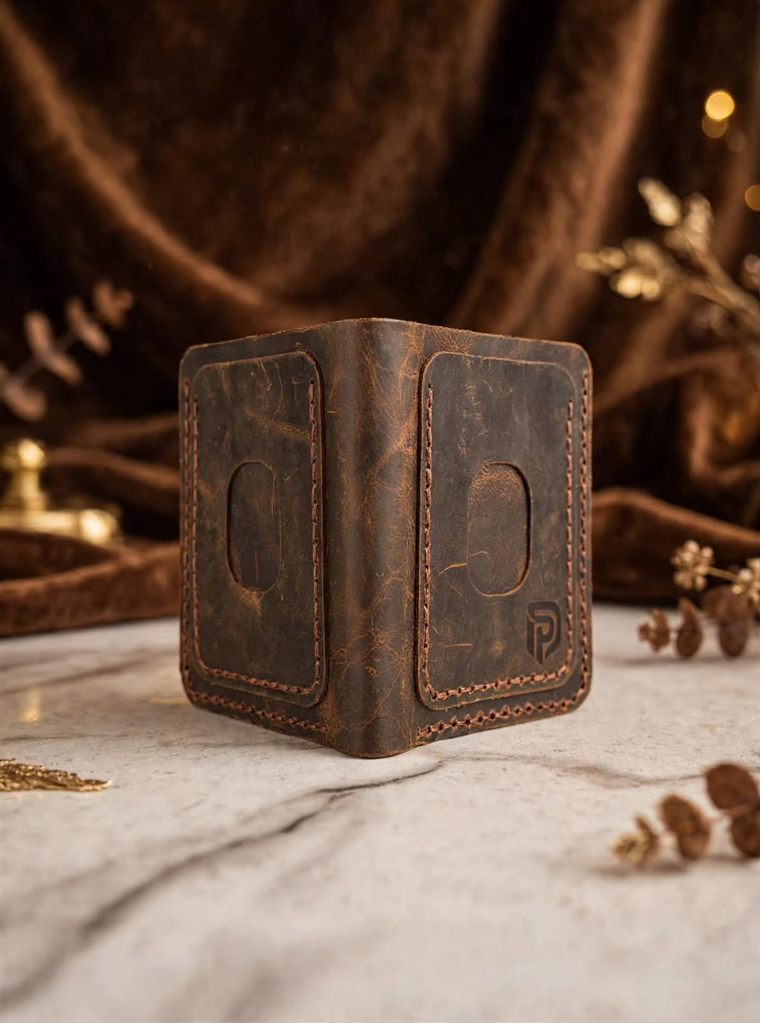
- Real leather: a cut edge shows dense, slightly rough fibres, a bit like the inside of suede. On better items the edge may be sanded, dyed and polished, but it still looks solid all the way through.
- Faux leather: the edge often shows layers, such as a plastic top layer over a fabric backing. It may be perfectly smooth, look rubbery, or be folded over and stitched to hide the layers.
- Bonded leather: the edge can look like pressed, papery fibres with a coating on top.
4. Look at the back
If you can see the reverse side, for example inside a jacket pocket or under a sofa cushion:
- Real leather usually has a fuzzy, suede-like back with loose fibres.
- Faux leather usually has a woven or knitted fabric backing, often with a visible regular mesh pattern.
Many wallets and bags are lined, so you may not be able to see the back. In that case the edges and the label matter more.
5. Feel and flex it
- Press it with your finger. Real leather usually wrinkles slightly and shows fine creases around the pressure point, then slowly relaxes. Faux leather tends to dent more evenly and spring straight back.
- Bend it. Real leather flexes with soft, natural creases. Thin PVC can feel stiff or plasticky, while some PU feels unusually soft and slippery.
- Temperature. Real leather tends to warm to your touch. Synthetics can stay cool and feel slightly sticky in warm, humid conditions.
Feel takes practice. Compare with an item you know is real if you can.
6. Smell it
Real leather has a rich, natural smell that most people recognise. Faux leather often smells of plastic or chemicals, especially when new.
This test is useful but not reliable on its own. Some faux leather is scented, and strong dyes, finishes or shop smells can hide the natural smell of real leather.
7. The water drop test (with limits)
Place one small drop of water on a hidden area and watch for a minute.
- On uncoated or lightly finished real leather, the drop slowly soaks in and darkens the spot slightly.
- On faux leather, the drop sits on the surface.
The catch: many real leathers have a protective finish, so the drop can sit on top of them too. A drop that soaks in is a good sign. A drop that sits on top proves nothing on its own. Always use a hidden spot and blot the water off afterwards.
What about the burn test?
You may see advice to hold a flame to leather. We don’t recommend it. It damages the item, can be dangerous, and is not allowed in shops for good reason. The checks above are enough in almost every case.
8. Consider the price
Good leather costs money to produce. A full grain leather jacket or bag at a very low price is a warning sign. Price alone doesn’t prove anything, because some sellers charge leather prices for synthetics, but it should make you look more closely.
Quick checklist
| Check | Real leather | Faux leather |
|---|---|---|
| Label | Full grain, top grain, suede, genuine | PU, PVC, vegan, leatherette |
| Surface | Irregular pores, small natural marks | Repeating pattern, very uniform |
| Edge | Dense fibres all the way through | Layers, fabric core, rubbery edge |
| Back | Fuzzy, suede-like | Woven or knitted fabric |
| Press test | Fine wrinkles, slow recovery | Even dent, quick spring-back |
| Smell | Natural leather smell | Plastic or chemical smell |
Is faux leather always worse?
Not always. Good synthetics can be practical: they are often cheaper, lighter and easier to wipe clean, and some people prefer not to use animal products. They usually don’t last as long as good real leather, though. Many crack or peel after a few years, and they don’t develop a patina. The important thing is to know what you are buying and to pay a fair price for it.
FAQ
Is “genuine leather” real leather?
Yes, it is real leather, but the term is often used for lower-grade leather, usually from a split layer with a coated surface. It is not a sign of top quality.
Is vegan leather real leather?
No. “Vegan leather” means a material made without animal skin, usually PU or PVC, and sometimes plant-based materials.
Does real leather crack?
It can, if it dries out or is exposed to heat. Regular cleaning and occasional conditioning prevent most cracking. Faux leather more often peels or flakes as its surface layer breaks down.
Can a seller legally call bonded leather “leather”?
Rules differ by country. Many places require bonded leather to be labelled clearly. If a description is vague, ask the seller directly what the material is.